Organizations preparing for a CMMC Level 2 assessment often focus on documentation and control implementation, yet the most significant predictors of assessment success relate to alignment, consistency, and stability across their environment. As a C3PAO performing official assessments, Coalfire Federal has observed clear patterns that distinguish organizations that move smoothly through their assessment from those that experience delays or rework. This report outlines the five foundational conditions that consistently predict successful outcomes. These conditions reflect assessment observations only, not advisory guidance. They provide a readiness framework for organizations to validate before their scheduled assessment window.
Preparing for a CMMC Level 2 assessment begins long before Day One. By the time an organization schedules its assessment window, the foundational elements of readiness should already be in place. Successful assessments rarely hinge on a single technical control. Instead, they reflect alignment between scope, documentation, evidence, personnel, and system stability. When any of these elements are misaligned, assessments take longer, generate more friction, or must be rescheduled. Across official CMMC Level 2 assessments, these five conditions most reliably separate organizations that are truly ready from those that are not.
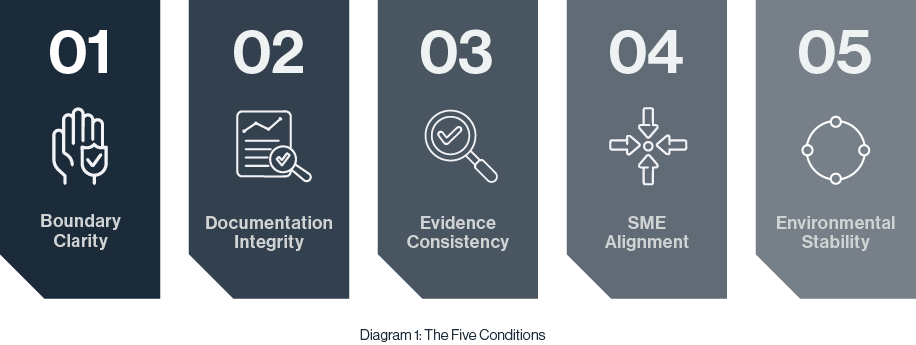
Across assessments conducted by our teams, five conditions emerge as the strongest predictors of a smooth and efficient Level 2 assessment. These conditions are not steps in a process or a prescriptive order of operations. They are the environmental and organizational markers that indicate true readiness. Each condition includes requirements, indicators, red flags, and assessment field insights.

A defined, validated, and stable scope that accurately reflects where CUI resides and flows.
| Indicators | Red Flags |
|---|---|
| ✓ CUI repositories are documented and confirmed by system owners | ✕ New CUI locations discovered during evidence preparation |
| ✓ System diagrams match actual configurations | ✕ Legacy repositories not reviewed |
| ✓ Provider responsibilities are understood and documented | ✕ Over-reliance on tools without validating boundaries |
| ✓ No unverified assumptions about CUI handling | ✕ Architecture changes close to the assessment window |
In more than half of delayed assessments, inaccurate or incomplete scoping is the root cause.
"The boundary that is being assessed needs to be clearly defined and documented. A high-level narrative of what is happening in the boundary is crucial to the assessment as it directs us where to look and what is in scope.”
Documentation must accurately reflect real operational practice.
| Indicators | Red Flags |
|---|---|
| ✓ Policies match current tooling and workflows | ✕ Documents updated immediately before assessment |
| ✓ The SSP describes controls as implemented | ✕ SMEs unfamiliar with documented procedures |
| ✓ SMEs recognize documented processes as accurate | ✕ Documentation written for compliance rather than operation |
| ✓ Version control aligns with actual system changes |
Most friction arises when documentation and practice diverge.
"We have seen instances when what the SME describes and how the document states a process is performed, do not align. Reviewing processes prior to the assessment to ensure they match operational practice helps avoid potential findings.”
Evidence is complete, consistent, current, and reproducible
| Indicators | Red Flags |
|---|---|
| ✓ Evidence mapped to assessment objectives | ✕ Evidence created specifically for the assessment |
| ✓ Logs and records show required recency and history | ✕ Missing or incomplete timeframes |
| ✓ Evidence sources support each other without contradiction | ✕ Manual processes that do not match policy |
| ✓ Evidence can be retrieved without custom extraction | ✕ Screenshots without metadata or corroboration |
Evidence misalignment is the most common driver of delays.
"Evidence provided needs to be mapped to the objectives it supports. A Traceability Matrix of artifacts to controls really helps the assessment process go smoothly.”
Subject matter experts understand and can demonstrate their responsibilities.
| Indicators | Red Flags |
|---|---|
| ✓ SMEs can explain processes without reading documentation | ✕ SMEs rely on consultants to explain processes |
| ✓ Control ownership is clearly defined | ✕ Turnover or unclear ownership |
| ✓ SMEs can locate and retrieve evidence | ✕ SMEs unavailable during assessment sessions |
| ✓ Backup SMEs are prepared |
Well prepared SMEs accelerate assessment sessions and reduce follow up requests.
"We can’t direct the SMEs how to get the evidence or how to show the configuration settings we are looking for. We have seen that OSCs who have prepared their SMEs to quickly provide demonstrations and only answer the questions being asked, perform much better.”
A stable environment without major changes that could impact documentation or evidence.
| Indicators | Red Flags |
|---|---|
| ✓ No system migrations pending | ✕ Upgrades scheduled near the assessment window |
| ✓ No tooling changes underway | ✕ Staff transitions affecting security functions |
| ✓ No redesigns or boundary adjustments | ✕ Unvalidated remediation efforts |
| ✓ All systems remain available for evidence retrieval | ✕ Active incidents involving CUI systems |
Most last minute reschedules result from environment changes within 60 days of assessment.
"Since we are doing point-in-time assessments the boundary being looked at needs to be properly documented and is considered that the scope of the boundary won’t change. We had a boundary shift during a Joint Surveillance assessment that caused the OSC to fail.”
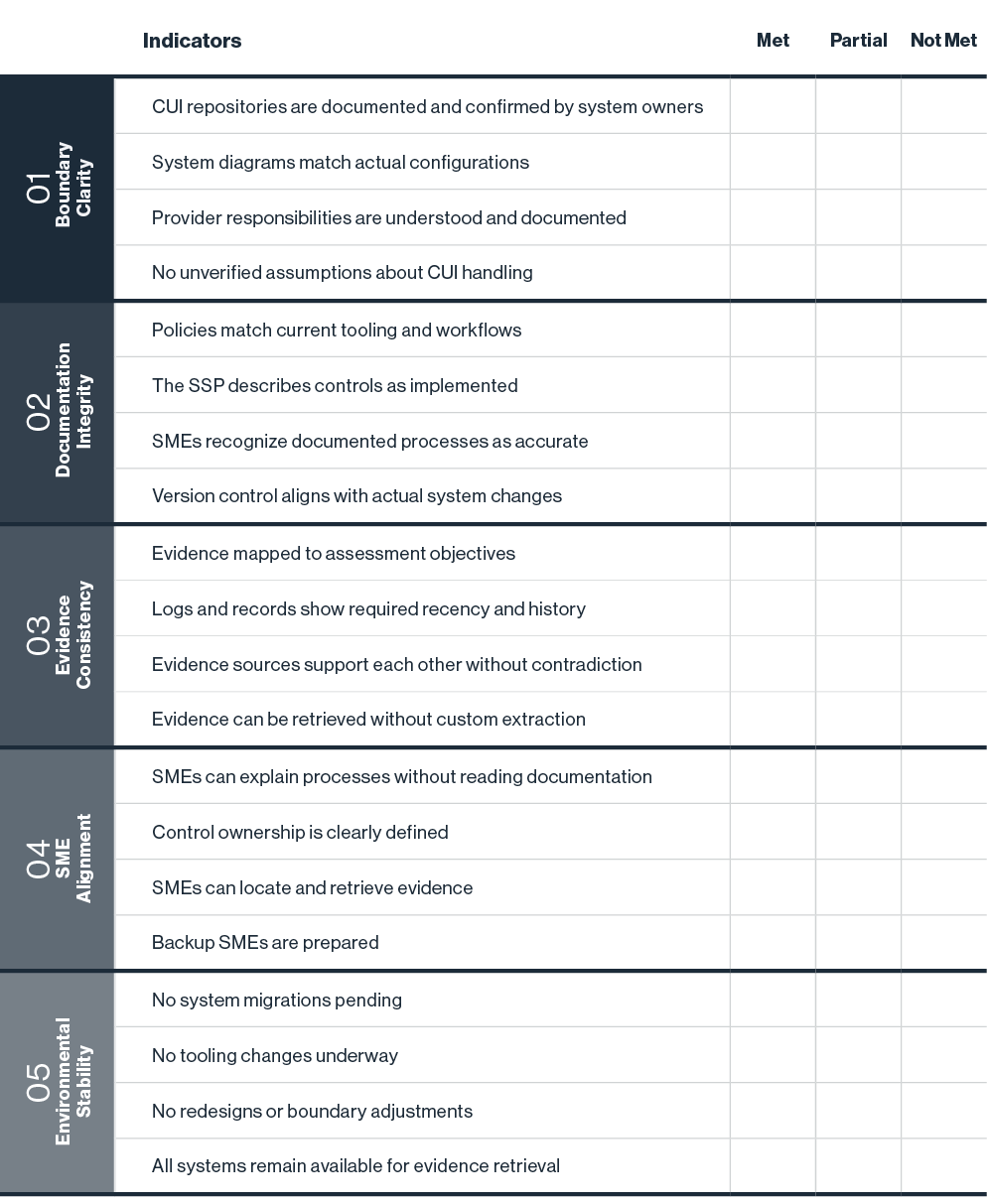
Use this scorecard to evaluate whether each condition is met, partially met, or not met.

Organizations that validate these five conditions before Day One consistently experience smoother and more predictable assessments. This insight report provides a readiness framework based solely on assessment observations and does not offer implementation guidance. Ensuring alignment between documentation, evidence, SMEs, and environmental stability reduces risk and increases confidence leading into a CMMC Level 2 assessment.